Uche Ajuonuma Senior Mechanical Engineer

← Selected work  ·  Sheet B-05

Intelligent Wellhead Systems  ·  2022 – 2023

Smart lockout & high-pressure wellhead control

Twenty-plus prototypes in the first ninety days. Then the unglamorous work that turned a fast learning loop into equipment people trust at pressure.
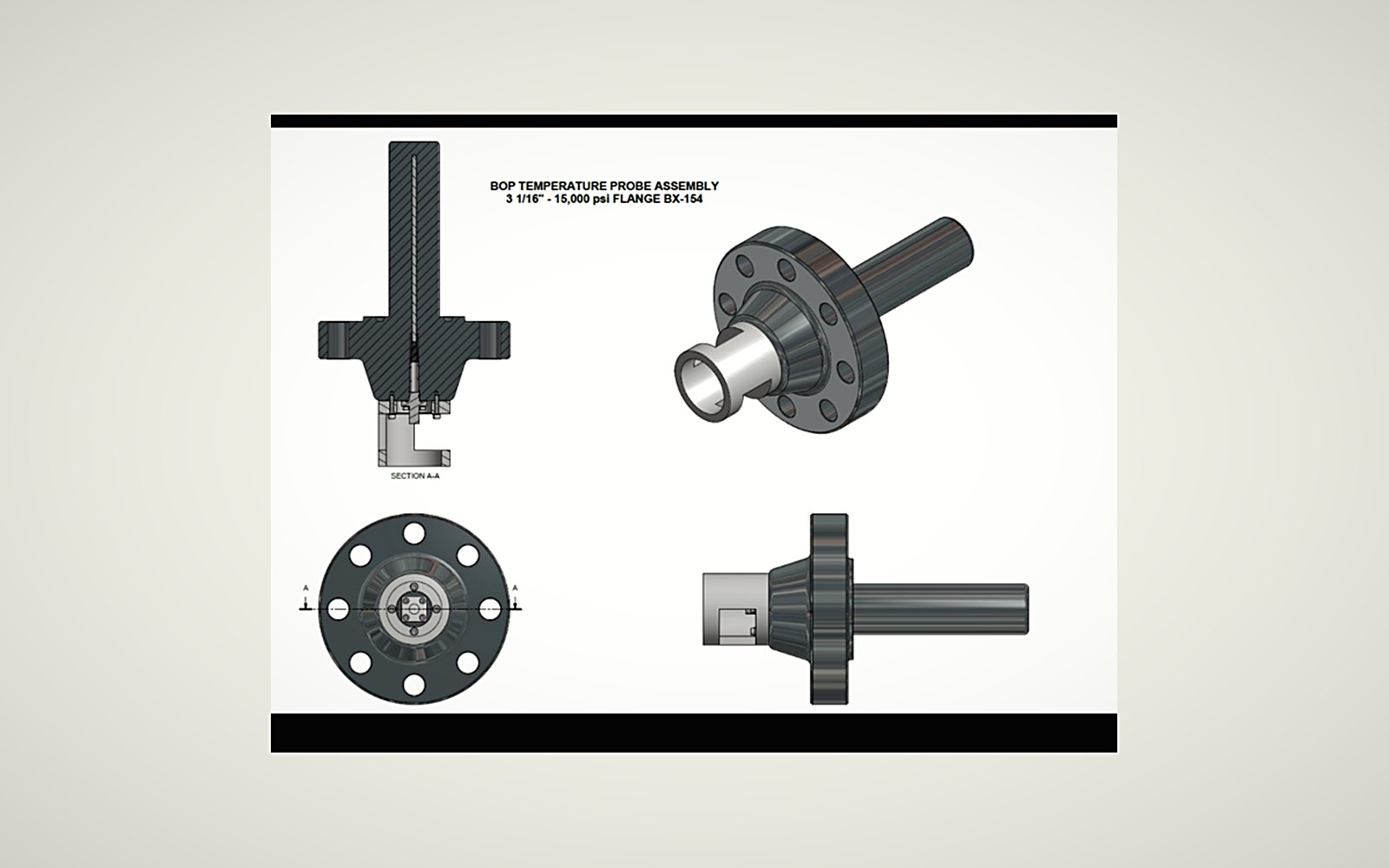
Engineering drawing of a wellhead temperature probe assembly with flange and sectioned views
Wellhead probe assembly — drawing extract
RoleR&D Engineer
SectorOil & gas
CodesASME B31.1 · CSA Z662 · OH&S
ToolsCAD · additive manufacturing
Period2022 – 2023
The constraint

A safety device that fails safe, and fails visibly

A wellhead lockout exists to guarantee that something cannot happen. That is a harder requirement than making something work, because you are not designing for the operating case — you are designing for the case where everything else has already gone wrong.

It has to hold at pressure. It has to be unambiguous to a person wearing gloves in poor light who is tired and in a hurry. It has to fail into the safe state rather than the convenient one. And on a wellsite it must survive handling that no laboratory ever simulates properly.

The approach

Twenty prototypes is a strategy, not enthusiasm

Twenty-plus prototypes in ninety days, using CAD and additive manufacturing, was a deliberate choice about where to spend uncertainty. When a design space has many plausible mechanisms, argument is a slow and unreliable way to choose between them. Building is fast.

A printed part answers questions an assembly model cannot: whether a gloved hand can operate it, whether the interlock is obvious without a label, whether two components can be assembled in the wrong order by someone who has not read the manual. Those are the questions that decide whether a safety device is actually safe in the field.

This is my father’s bench with a printer on it. Put the idea on the bench and find out.

Then slow down

Rapid prototyping tells you which concept is right. It tells you almost nothing about whether the production version will be reliable. That came from tolerance-stack analysis, field-issue investigation, iterative validation and corrective design driven by what customers and operating data actually showed.

The fifteen per cent reliability improvement lives entirely in that second phase. The prototypes got the attention; the stack-up work got the result.

Field data outranks your intent

Equipment in the field is used the way it is used, not the way the designer imagined. Investigating real failures and letting the findings change the design — rather than the operating instructions — is how a product gets genuinely better.

It is also uncomfortable, because most field failures are a design decision meeting reality. Which is exactly why they are worth reading carefully.

Sheet F-01

Working on something with this shape?

Start a conversation

Drawn by U. AJUONUMA
Sheet B-05
Title WELLHEAD CONTROL
Rev A
Issued 2026-08-25
Status OPEN FOR WORK