Uche Ajuonuma Senior Mechanical Engineer

← Selected work  ·  Sheet B-03

Solex Thermal Science  ·  2024 – 2025

Moving-bed heat exchanger redesign

Sixty per cent of the build time removed. None of it bought by accepting a worse machine.
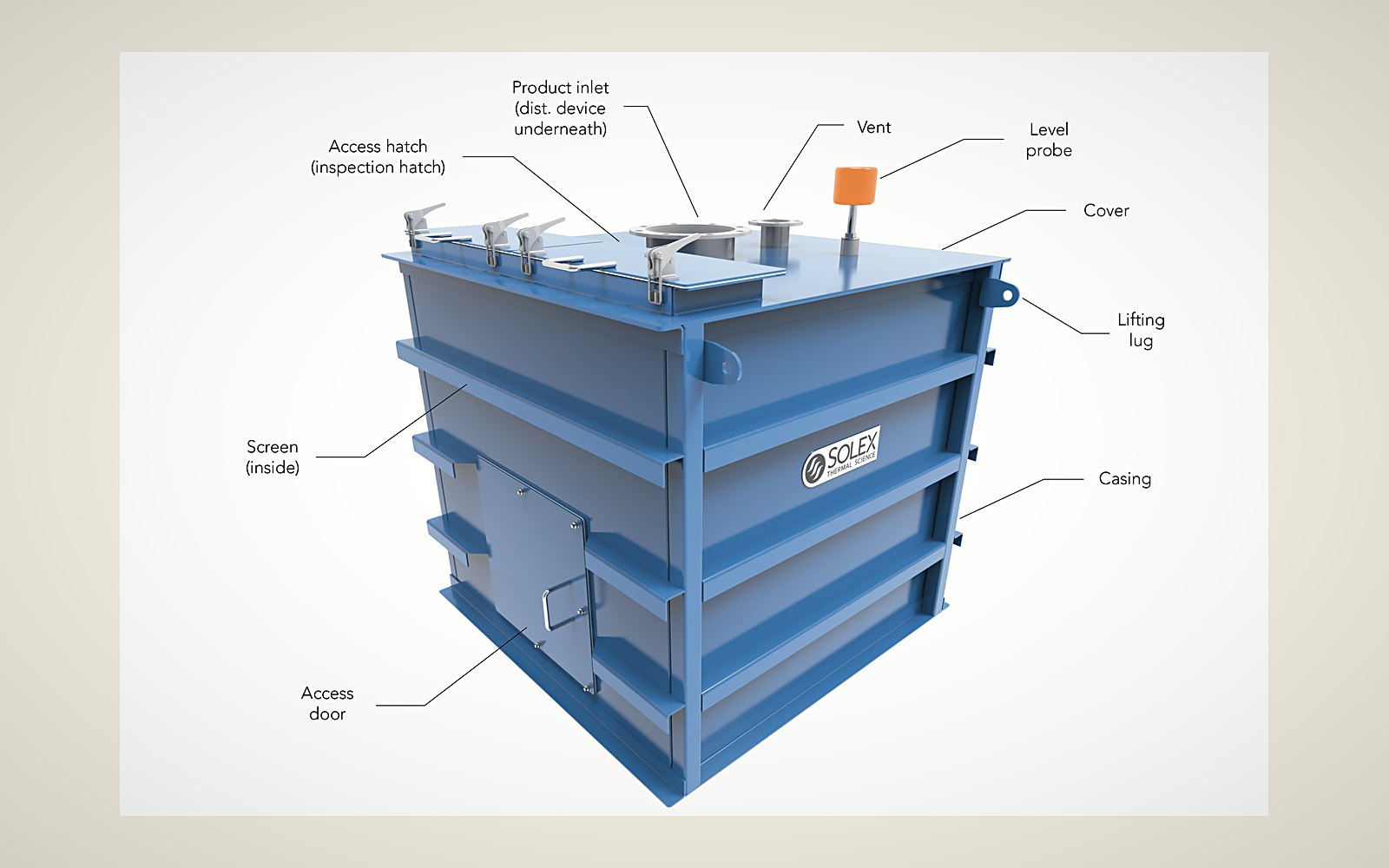
General arrangement of a moving-bed heat exchanger showing casing, product inlet, access hatches and lifting lugs
Moving-bed heat exchanger — general arrangement
RoleMechanical Design Engineer
SectorThermal processing
CodesASME BPVC VIII · CSA B51
ToolsSolidWorks · FEA
Period2024 – 2025
The constraint

Manufacturing cost lives in the drawing, not the shop

A moving-bed heat exchanger handles bulk solids under gravity across heat transfer plates. The thermal duty is set by surface area and residence time; the mechanical design has to hold that geometry, take the load of the material column, survive continuous duty and, where it is a pressure part, satisfy Section VIII.

The awkward truth about equipment like this is that most of the manufacturing cost is committed by decisions taken on a screen, months before anyone cuts plate. Weld length, joint preparation, fit-up tolerance, part count, handling weight, how many times an assembly has to be turned over. All of it is decided in CAD and paid for in the shop.

The approach

Ask the shop first, not last

Design-for-fabrication reviews before the configuration was frozen, not afterwards as a correction exercise. The questions are unglamorous and they are where the sixty per cent came from: does this joint need full penetration or has it just always been drawn that way; can this weld be reached in the flat position; how many separate fit-up operations does this sequence require; is this tolerance protecting a function or protecting a habit.

Almost none of it was clever. It was systematically removing work that was not carrying any load — structural, thermal or functional.

Prove that nothing was given back

A sixty per cent reduction in build time is only worth having if the machine is the same machine. Every change went back through stress calculation, FEA and material selection, and against the Section VIII and CSA B51 requirements for the pressure-retaining scope.

That verification loop is what separates a redesign from a cost-down. A cost-down finds savings and hopes. A redesign finds savings and then goes and demonstrates that the structural, thermal and duty-cycle behaviour is intact.

Follow it all the way to commissioning

I stayed with this equipment through supplier drawing and submittal review, shop inspection, test readiness, installation planning, technical issue resolution and commissioning closeout.

Engineers who never see their equipment commissioned keep making the same small mistakes for a whole career, because nothing ever comes back to tell them. The feedback loop is the education. It is also, incidentally, how you learn which of your drawings were promises you could keep.

Sheet F-01

Working on something with this shape?

Start a conversation

Drawn by U. AJUONUMA
Sheet B-03
Title MOVING-BED HEAT EXCHANGER
Rev A
Issued 2026-08-25
Status OPEN FOR WORK