Uche Ajuonuma Senior Mechanical Engineer

← Selected work  ·  Sheet B-04

SKF Group  ·  2020 – 2022

Maglev bearings & neutron choppers

A rotor that touches nothing. When contact is designed out, the tolerance stack stops being a detail and becomes the product.
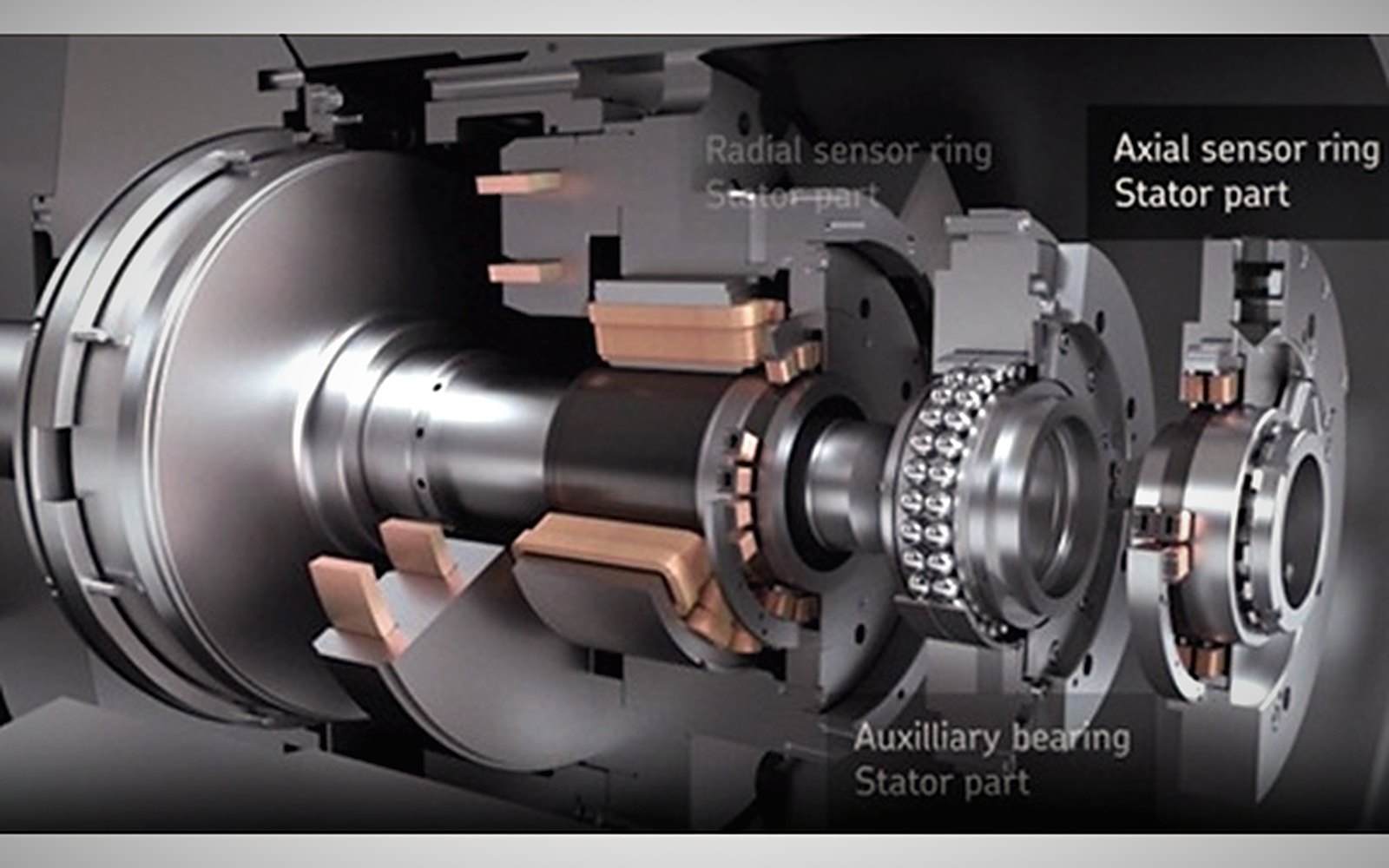
Cutaway of a magnetic levitation bearing showing radial and axial sensor rings, stator parts and auxiliary bearing
Magnetic bearing assembly — sectioned view
RoleMechanical Designer / Validation Engineer
SectorPrecision rotating machinery
CodesInternal standards
ToolsSolidWorks · FEA · test rigs
Period2020 – 2022
The constraint

The air gap is the whole machine

In a magnetic bearing the rotor is held in a field with no mechanical contact. Everything good about that — no friction, no lubricant, no wear, very high speed — follows from a gap that is small and must stay small and uniform.

Which means the entire mechanical design exists to protect a clearance. Every tolerance in the stack, every thermal growth path, every deflection under load, every mounting interface either preserves that gap or eats into it. There is no slack anywhere to absorb a sloppy assumption, and the consequences of losing the gap arrive at operating speed.

The approach

Tolerance analysis as a design activity

Tolerance stack-up is usually treated as a check performed on a finished design. On a machine like this it has to drive the configuration: how the parts locate, which datums carry the critical relationships, where the interfaces are placed so the chain is short.

A long tolerance chain across a critical clearance is a design decision, not an unfortunate outcome. Shortening it is nearly always cheaper and more reliable than tightening every element in it.

Static analysis will not save you

These assemblies run at speeds where rotordynamics governs. A design that is entirely sound in a static FEA can still be unusable, because the question is not whether it holds together but how it behaves near its critical speeds, what the unbalance response looks like, and whether thermal growth moves the gap during a run.

That is why the validation work was not a formality. Rotational performance testing was the point at which the design either was, or was not, what the model claimed.

Let the test data win

The twenty per cent reduction in production errors came from failure investigation and taking test results at face value: finding the actual root cause, changing the design or the drawing, and re-verifying — rather than explaining why the measurement must be wrong.

The instinct to defend your own design is strong and it is expensive. My father used to let the material tell him he was wrong. It is faster.

Sheet F-01

Working on something with this shape?

Start a conversation

Drawn by U. AJUONUMA
Sheet B-04
Title MAGLEV BEARINGS
Rev A
Issued 2026-08-25
Status OPEN FOR WORK