Uche Ajuonuma Senior Mechanical Engineer

← Selected work  ·  Sheet B-02

Westinghouse Electric Canada  ·  2023 – 2024

Cobalt-60 in-bay handling equipment

Equipment for a bay you cannot enter, handling a source you cannot approach. Every maintenance action has to exist on the drawing before anyone needs it.
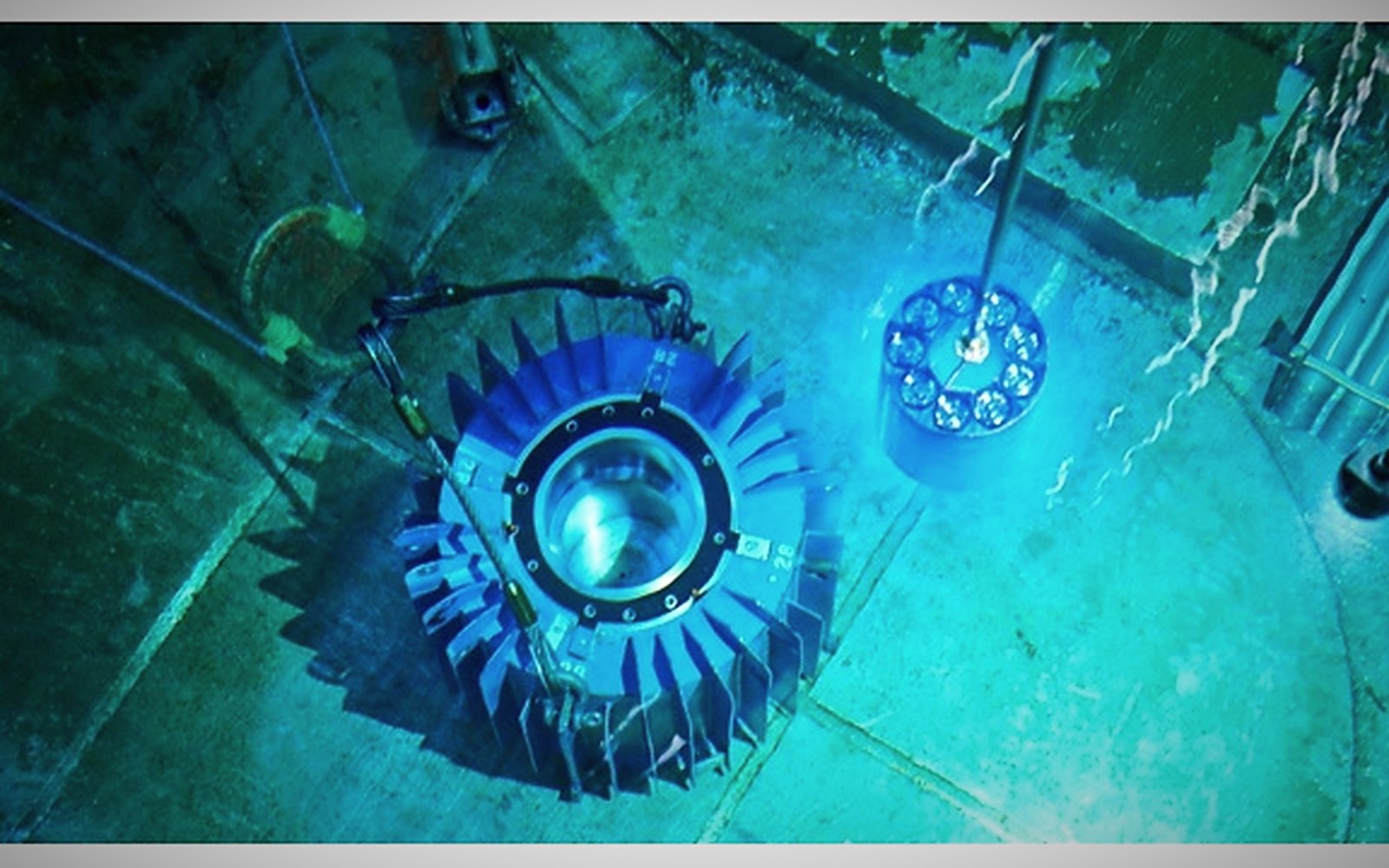
An irradiated assembly glowing blue under water in a reactor bay
Illustrative — in-bay environment
RoleSenior Mechanical Designer
SectorNuclear services
CodesCSA N285.0 · ASME B31.3 · ASME Y14.5
ToolsSolidWorks · PDM
Period2023 – 2024
The constraint

No hands go in

Ordinary mechanical design carries an unstated assumption: if something jams, a person walks over and frees it. Remove that assumption and a great deal of reasonable-looking design becomes unusable.

In a Cobalt-60 bay every operation happens at distance, through water, with constrained tooling and constrained sight lines. A fastener that needs two hands, a component that has to be held while another is aligned, a part that can be installed backwards — each of these is a straightforward annoyance in a machine shop and a serious event here.

So the design problem is not really the equipment. It is the full set of actions a human will ever need to perform on it, worked out in advance, and then made possible by the geometry.

The approach

Design the sequence, then the part

The useful discipline is to write the operating and maintenance sequence before the configuration is fixed. Install, operate, inspect, recover from the jam, remove, replace. Each step gets an answer in terms of what a tool can reach and what an operator can see.

Features that only exist to serve those steps — captive fasteners, asymmetric interfaces that cannot be assembled wrong, lead-ins that let a tool find a feature without vision, deliberate single-tool access — stop being nice-to-haves and become the requirement.

Formal review as the actual product

I led the design reviews and the technical issue closure on this equipment. The purpose of a review here is not approval; it is to find the interface conflict, the constructability problem and the maintainability trap while they are still lines on a screen.

Every conflict found in a review is a conflict that does not get found in a radiological environment by someone holding a long tool. That is the entire economics of the exercise, and it is why I have never regarded review preparation as overhead.

GD&T as communication, not decoration

With CSA N285.0 documentation requirements and remote assembly, tolerancing has to say what actually matters: which surface locates, what has to be perpendicular to what, and where the tolerance is genuinely available. A drawing full of tight tolerances that were never functionally required is a drawing that makes the part expensive and still fails to protect the fit that counted.

Handing it on

Part of the job was bringing junior designers up in SolidWorks, GD&T, PDM revision control and nuclear-quality documentation. Nuclear-grade documentation discipline is not intuitive and it is not optional, and the fastest way to teach it is on live work with the reasons attached.

Sheet F-01

Working on something with this shape?

Start a conversation

Drawn by U. AJUONUMA
Sheet B-02
Title CO-60 HANDLING EQUIPMENT
Rev A
Issued 2026-08-25
Status OPEN FOR WORK